
Kids padel is growing — and parents have questions
Padel is the fastest-growing sport in Portugal. And with it, the number of children and teenagers entering padel schools keeps increasing. For many parents, it's new territory: they didn't play padel as children, don't know the developmental stages, and aren't quite sure what to expect.
This guide answers the questions parents ask most — without technical jargon and with realistic expectations.
What age can they start?
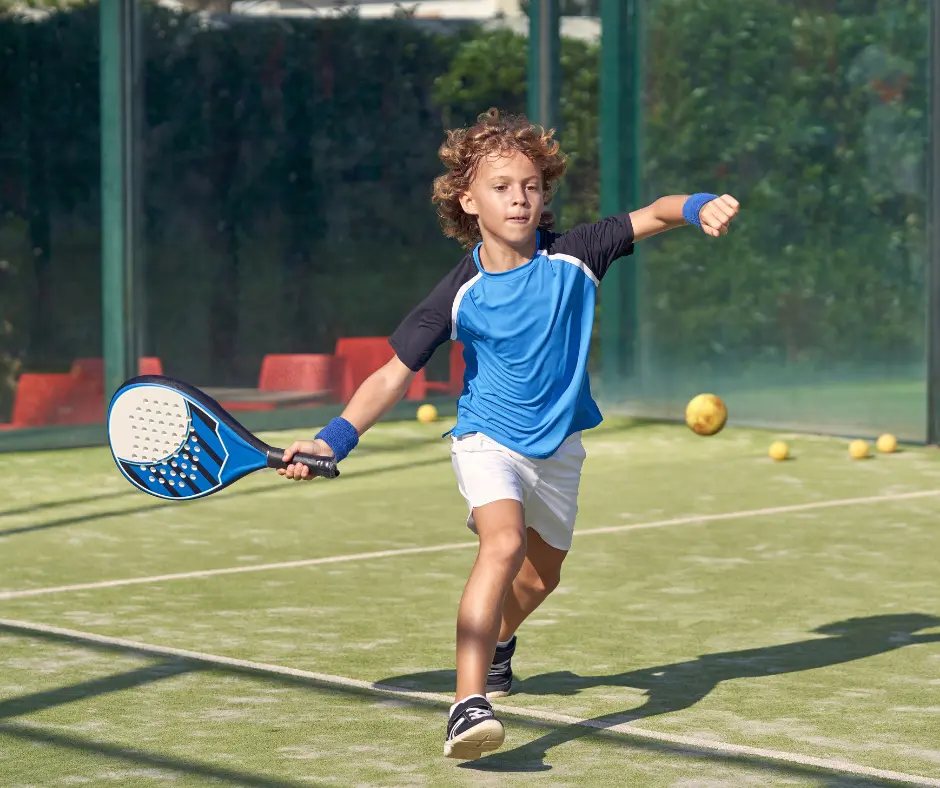
Most padel schools accept children from age 5-6. But "starting padel" at this age doesn't mean serious padel training. It means:
- Games with foam balls or low-pressure balls
- Coordination and motor skills exercises
- Getting familiar with the racket and the court
- Lots of play, minimal formal technique
What parents should know: A 6-year-old isn't going to learn how to hit a bandeja. They're going to learn to run, jump, hit a ball, and have fun. And that is exactly what should happen.
Actual prerequisites
There are no technical prerequisites. But it helps if the child:
- Can follow simple instructions in a group
- Can tolerate some frustration (not every ball goes where we want)
- Enjoys physical activity in general
If your child cries when they lose or refuses to share, that's not a reason not to start — but it's something to communicate to the coach so they can adapt their approach.
The progression stages: what to expect
Stage 1: Introduction (ages 5-8, or first 6-12 months)
What the child learns:
- Holding the racket correctly (Continental grip)
- Hitting the ball forehand and backhand with some consistency
- Positioning on court (basic spatial awareness)
- Playing cooperatively (keeping the ball in play, not winning points)
What parents should expect:
- Lots of errors. The ball goes everywhere and that's normal.
- Short sessions (30-45 minutes). Concentration capacity is limited.
- Good days and bad days. Consistency comes with time.
- Slow but steady progress. Don't measure it week by week.
What NOT to expect:
- That the child plays like adults
- That they win games or tournaments
- That they have "correct" technique on every shot
- That they're motivated in every session
Stage 2: Development (ages 8-11, or after 1-2 years of practice)
What the child learns:
- Basic volley (net position)
- Serve with some direction
- Simple tactical awareness (playing to the open space)
- Beginning of doubles play with basic communication
What parents should expect:
- The child starts to "read" the game — anticipating where the ball will go
- Can maintain longer rallies
- Starts having preferences (enjoys attacking or defending more)
- May want to compete in beginner tournaments
Warning: This is the stage when many parents start pushing — and many children start quitting. Early competitive pressure is the biggest enemy of youth sports development.
Stage 3: Specialisation (ages 11-14, or after 2-4 years of practice)
What the child learns:
- More technical shots (bandeja, vibora, lob)
- Advanced tactical positioning (when to move up, when to drop back)
- Organised doubles play (who covers what)
- Emotional management in competition
What parents should expect:
- More visible and measurable progress
- The child starts to have a playing identity
- Can compete regularly if they want to
- Will need more sessions per week to improve
How to support (without pressuring)
What works
-
Ask "did you have fun?" before "did you win?" The question we ask in the car defines the priority. If the first question is about results, the child learns that the result is what matters.
-
Be present, not intrusive Going to watch training is great. Shouting instructions from the stands is counterproductive. The coach is managing a group — external interference complicates things.
-
Respect the bad days The child won't be motivated in every session. That's normal. Forcing it on difficult days creates aversion to the sport.
-
Trust the process Progress in sport is irregular. There are weeks of plateau followed by visible leaps. If you trust the coach, give them time.
-
Celebrate effort, not just results "You really put in the effort today" is more powerful than "you played well today." Effort is within the child's control; the result isn't always.
What to avoid
-
Comparing with other children. Every child has their own rhythm. Joao, who started at the same time, might progress faster in one aspect and slower in another.
-
Training at home without guidance. Unless the coach asks for it, don't try to correct technique at home. You might create habits that contradict what's being taught.
-
Changing schools/coaches frequently. Consistency is more important than finding the "perfect" coach. Every change restarts the adaptation process.
-
Projecting ambitions. Not every child who plays padel will become professional. Most will simply have a healthy activity, make friends, and learn to handle victory and defeat. And that's an excellent outcome.
Communication with the coach
What to ask (and when)
Most coaches have little time between sessions. Respect that and opt for concrete, spaced-out questions.
Good questions (every 3-4 weeks):
- "What are you working on right now?"
- "Is there anything we can reinforce at home?"
- "Is the progress on track?"
- "Is there any behaviour I should know about?"
Questions to avoid:
- "Why didn't they win the match?" (Results aren't the focus in development)
- "Is their classmate X better?" (Comparisons don't help)
- "Shouldn't they be doing more technique?" (Trust the coach's planning)
Coaches who use feedback platforms
Some coaches use platforms like FeedxBoost to send structured reports after sessions. This solves two problems: the parent receives concrete and regular information, and the coach doesn't need to answer individual messages constantly.
If your child's coach uses this type of tool, make the most of it. Read the reports carefully and save your questions for in-person conversations.
Equipment: what to buy (and what not to)
Essential
- Racket appropriate for size: Children's rackets (up to age 10-11) are lighter and shorter. Don't buy an adult racket "to grow into" — it harms technique and can cause injuries.
- Padel or court tennis shoes: Soles appropriate for the court surface. Don't use running shoes or football boots.
- Comfortable clothing: Nothing special. Sports clothes will do.
Unnecessary (at the start)
- Expensive brand racket (until they have basic technique)
- Various grips/overgrips
- Competition balls (training balls are enough)
- "Professional" accessories
When to change racket
The coach is the best person to indicate when it's time to change. Typical signs:
- The child has grown and the racket looks small
- Technique has evolved and the racket is limiting
- The racket is damaged
When to worry (warning signs)
In the vast majority of cases, padel is a safe and positive activity. But be alert to:
- Persistent pain: Any pain lasting more than 2-3 days should be evaluated. Wrist and elbow are the most common.
- Consistent refusal: If the child consistently refuses to go to training (more than 3-4 weeks in a row), talk to them and to the coach. It could be the group dynamic, the level of demand, or simply loss of interest.
- Pre-training/tournament anxiety: If the child becomes anxious or cries before sessions, something needs adjusting — it could be external pressure (parents, peers) or internal (perfectionism).
- Over-training: More isn't better. For children up to 12 years old, 2-3 sessions per week is appropriate. More than that increases the risk of injury and burnout.
Conclusion: Padel is a journey, not a destination
The goal of kids padel isn't to create professionals. It's to give children an activity that develops coordination, teamwork, emotional management, and above all, joy in movement.
If your child leaves the court smiling — even if they lost every point — the training fulfilled its purpose.
The rest comes with time, practice, and patience. From everyone: child, coach, and parents.